Script or calculation field

xmlFM has been originally created to be used through scripts. This is an extremely easy and powerful solution, that can be integrated to a large set os usage.

From now, it is possible to extract any XML information from a « calculation field ». Indeed, we have developed specific « customized function » that can be integrated in your computation filed !

Hope you will enjoy this new powerful option !

Version history

[2019.04.17] v1.4
– corrected : incorrect parameter extraction (with « custom function ») for last item in list (thanks to Henry)
– improved : adding more tests scenarios

[2018.01.03] v1.3
– improved : documentation and sample code for « custom functions »

[2018.12.13] v1.2
– added : example to extract the node value as <Account No= »17-440077-01″ Name=« RICHARD JONES » > (thanks to Brian)

[2018.04.17] v1.1
– corrected : handling of occurence within last node element (thanks to « Vortex »)
– added : now handles empty-element tag as <line-break /> or <line break= »final » />

[2018.04.15] v1.0
Initial release

How to install ?

If you have tested successfully xmlFM, it is now time to install it ! And this is extremely easy.
Follow these 3 steps :

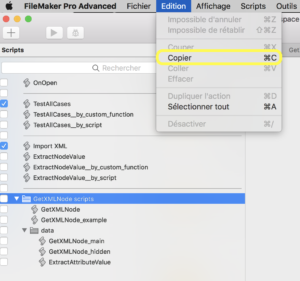
  1. Open your own copy of xmlFM, go in the script menu, and copy the complete folder « GetXMLNode scripts »
  2. Open the script viewer of your own FileMaker document, and paste the folder scripts (see step 1)
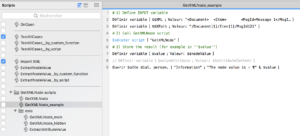
  3. You should now connect your scripts to xmlFM. You can get largely inspired by the script « GetXMLNode_example« .

    If you prefer to create from scratch, here are the main steps :

    1. Create your own script
    2. Define the input variables :
      1. « $$XML » should contain the XML document to parse
      2. « $$XPath » is the path to the element content you want to extract. Its syntax consisting of a series of xml nodes formatted as follows :

        /nodeName[instanceNumber]

    3. Call scripts « GetXMLNode »
    4. The results are in the following variables :
      1. « $$nodeValue » contains the requested element content pointed by $$XPath.
        It will contain «  » in case of error.
      2. « $$attributeContent » contains the attributes of the element pointed by $$XPath.

Version compatibility

As xmlFM is based only on scripts, it has a large compatibility with FileMaker products.

Recommended version

The recommended version is V12.0 and upper.
Compatible with Pro, Advanced, Server and Go version.

xmlFM has been successfully tested on latest FileMaker 16.0 (MacOS 10.13 and PC Windows 7 x64).

Minimum version

It is possible to run xmlFM on FileMaker v8.0 or upper with minor modification. Ask if you need it.

Parse any XML document within FileMaker

You can use xmlFM to parse any XML document within FileMaker in order to get :

  • element content
  • attribute value

Advantages

In contrast to several other existing FileMaker solution, xmlFM has the following advantages :

  • xmlFM is compatible with a wide selection of FileMaker versions
  • xmlFM does NOT need any plugin to be installed, neither to be deployed !
    It is just a set of FileMaker scripts installed in about 30 seconds !
  • xmlFM does not need any internet connection to work. It is 100% offline !
  • xmlFM is robust and it supports perfectly comments, and attributes in the XML document. Try it here.
  • xmlFM handles correctly empty-element tag (as <line-break />)

Example

Imagine you have the following XML file :

<Document>
<Item>
<MsgId>Message 1</MsgId>
<!– comment are ignored correctly –>
<MsgId>Message 2</MsgId>
<!– multiline comment are ignored correctly
<MsgId>Message WRONG</MsgId>
  –>
<!– attributes are managed correctly –>
<MsgId Ccy= »ENGLISH »>Message 3</MsgId>
</Item>
</Document>


You want to obtain the element content « Message 3 » and its attribute « ENGLISH » ?  The solution is xmlFM :
GetXMLNode( /Document[1]/Item[1]/MsgId[3] )

Some explanations, the previous syntax is for :

  • Go to first occurence of root tag « Document« 
  • Then, go to its first child tag named « Item« 
  • Finally, go to the third occurence of it child, with the tag named « MsgId« 

From there you will get the element content : « Message 3 », and its attribute : « ENGLISH ».

What is this ?

This site starts with the following

  • FileMaker is a great tool to automated tasks
  • XML is heavy used in modern transactions, for example, we can site :
  • There is no simple and robust method to read these XML document in FileMaker

The solution is xmlFM set of scripts.